East of Eden. The Land of Wandering. The Realm of Exile.
One sentence. Twenty words. And then the text just — moves on.
What happens when you follow Cain into the Land of Nod? And what happens when you can't get back out?
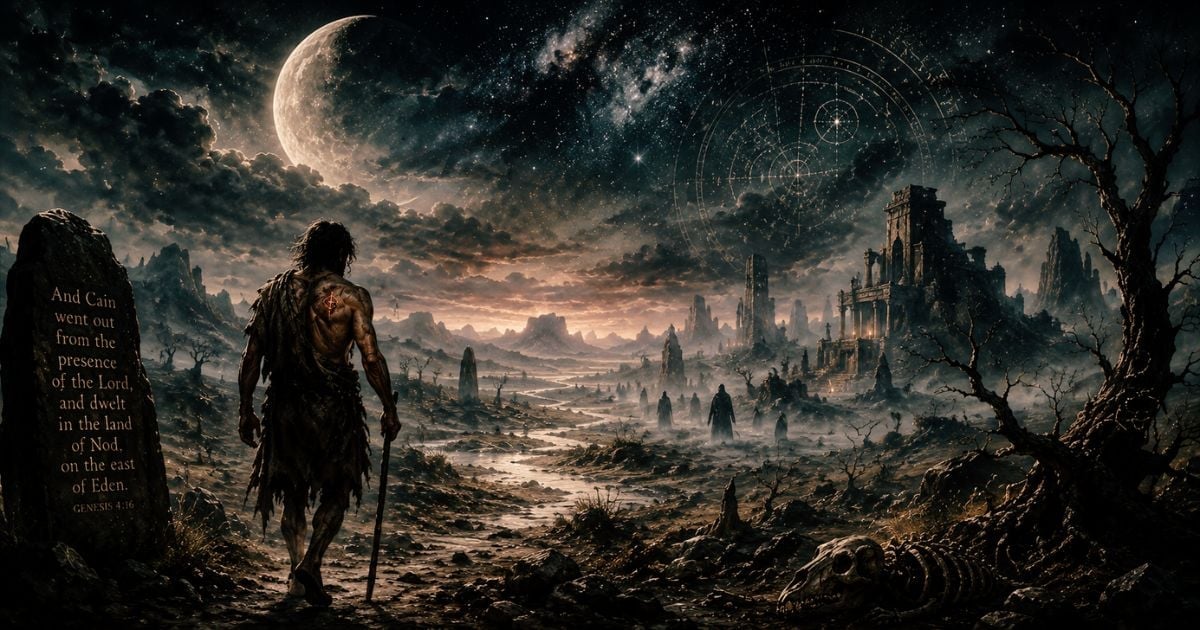
East of Eden. The Land of Wandering. A realm that has been waiting since Cain walked away from Paradise.
Here is the entirety of what the Bible tells you about the Land of Nod.
"Then Cain went out from the presence of the Lord and dwelt in the land of Nod, on the east of Eden."
— Genesis 4:16
One sentence. Twenty words, give or take depending on your translation. And then the text just — moves on. Like it didn't just drop one of the most tantalizing geographical references in the history of religious literature and casually walk away.
East of Eden. The Land of Nod.
That's it. That's all you get.
No description of what it looks like. No indication of how large it is. No explanation of who or what already lives there. No map. The author of Genesis apparently decided that the location where the first murderer was exiled after the first murder didn't warrant elaboration, which is either the most restrained editorial decision in literary history or evidence that the full story was considered too complicated — or too dangerous — to commit to the canonical record.
I've been thinking about that sentence for a good while. And the more you pull on it, the more it unravels.
Let's start with the name, because it matters.
Nod comes from the Hebrew nud — meaning to wander, to be a fugitive, to move without purpose or destination. It is not so much a place name as a condition. God's curse on Cain was explicit: a fugitive and a wanderer you shall be on the earth. And so Cain went to the land whose very name meant wandering. The place of exile was named for what exile is.
This is not coincidence. The ancient Hebrew writers were precise about this kind of thing. Names carried weight. Names were substance. The Land of Nod is the Land of Wandering — a realm defined not by geography but by the state of its original inhabitant. It is the place you go when you have been cast out from the presence of God. It is what lies east of Paradise when you can no longer return to it.
The phrase "east of Eden" appears twice in Genesis. First in chapter 3, when Adam and Eve are expelled from the garden — God places cherubim to the east of Eden to guard the way back to the Tree of Life. Then in chapter 4, Cain goes east again. Each generation pushed further from the origin. Each exile compounding the last. East is the direction of separation, of increasing distance from the divine center. It is not a compass bearing so much as a cosmological statement.
And Nod is at the far end of it.
Here's the thing about Genesis 4 that should stop you cold if you read it carefully.
After Cain settles in Nod, he finds a wife and has children. He builds a city. His descendants develop music, metallurgy, and animal husbandry. There is, in other words, a civilization in Nod — established with a speed and a completeness that raises an obvious and deeply uncomfortable question.
Where did all these people come from?
If Adam and Eve were the first humans, and their children at this point in the narrative are Cain and the recently deceased Abel, then who exactly is Cain marrying in the Land of Nod? Who are the people populating the city he builds? The text doesn't explain. It simply proceeds as though an existing population in Nod is the most natural thing in the world, requiring no elaboration.
Theologians have been wrestling with this for centuries, and the answers range from the mundane to the genuinely strange. The most common orthodox response is that Genesis compresses time — that Adam and Eve had many more children than the text explicitly names, and Cain married a sister or a niece. This is theologically defensible but narratively unsatisfying, because it doesn't explain why the Land of Nod is treated as a destination rather than an empty wilderness.
You go to Nod. You don't simply end up there. The text implies the place already exists, already has a name, already has some kind of identity before Cain arrives.
The more interesting possibility — and the one that has animated occult and mythological speculation for a very long time — is that the people of Nod were not descended from Adam and Eve at all. That there was, before or alongside the Edenic creation narrative, another population. A different origin. A lineage that predated or ran parallel to the one Genesis focuses on. The Land of Nod was not empty because it had never been empty.
Who those people were, and what their relationship to the divine order might have been, is where the speculation gets genuinely fascinating.
Let's talk about the Mark of Cain, because it's inseparable from Nod and almost always misunderstood.
The popular conception of the Mark of Cain is that it was a punishment — a brand of shame, a visible sign of guilt, something to mark Cain as a murderer and an outcast for all to see.
The text says something quite different.
God placed the mark on Cain specifically to protect him. Cain had complained that whoever found him would kill him — and God's response was to mark him so that anyone who killed Cain would suffer vengeance seven times over. The Mark of Cain is a divine protection. It is a ward. It is God saying: this man is under my protection regardless of what he has done, and you touch him at your peril.
"And the Lord said to him, 'Therefore, whoever kills Cain, vengeance shall be taken on him sevenfold.' And the Lord set a mark on Cain, lest any finding him should attack him."
— Genesis 4:15
Which raises its own question. Who was Cain afraid of? If the only humans in existence at this point were Adam, Eve, and himself — who exactly was he worried about finding him and killing him?
The text's answer is implicit and the tradition's answer is explicit: there were others out there. The world was populated. And those others, whoever they were, were dangerous enough that Cain needed divine protection before he could safely enter their territory.
Enter Nod.
The occult and mystical traditions built a great deal on this foundation. Various Gnostic sources identify the people of Nod as a pre-Adamic race — beings who existed before the Edenic creation, outside its moral and spiritual framework, operating under entirely different rules. The Watchers who later descended to Earth and took human wives — the disaster chronicled in the Book of Enoch — would have found in Nod's population beings who were neither the divine order's angels nor the Edenic order's humanity. Something in between. Something older.
The Mark of Cain, in some of these traditions, did more than protect him. It changed him. Marked him as something new — the first human to commit murder, the first to transgress the most fundamental prohibition, the first to carry in his blood a knowledge that no human before him had possessed. The knowledge of what it means to end a life. That knowledge, these traditions suggest, was passed to his descendants in Nod and mixed with whatever the original inhabitants of that place already carried.
What came out of that mixing was something the world had not seen before and has not been able to fully account for since.
Here's where the mythology shifts from ancient texts to what I find most compelling — the long arc of what Nod means as a concept, as a place, as a presence in the deep structure of the supernatural world.
In the traditions that take it seriously — and there are more of them than you might expect — Nod is not simply a geographical location east of a garden that no longer exists. It is:
It is, in other words, precisely what you'd expect the place to become after millennia of accumulating everyone and everything that has been cast out, shut out, or pushed to the margins of the ordained order.
Cain built a city in Nod. The text tells us this. He called it Enoch, named for his son — the same name, notably, as the antediluvian prophet who walked with God and was taken up without dying. Cain naming his city for his son while the other Enoch was being received directly into the divine presence is a juxtaposition that feels deliberate, though I couldn't tell you exactly what it means. Two Enochs. Two lineages. Two responses to the same expulsion from Paradise.
The city of Cain's Enoch was built in the Land of Wandering, in the realm of exile, by the first man to spill blood. Everything that followed — the civilizations his descendants built, the technologies they developed, the knowledge they accumulated outside the gaze of Heaven — all of it grew from that foundation.
The flood came and buried most of it.
But you already know my position on things that get buried.
They wait.
There's one more piece of this that I can't leave out.
The Hebrew word nud — wandering, fugitive — is also the root of the English word nod. As in the drowsy, half-conscious state between waking and sleep. As in the Kingdom of Nod, the place you go when you drift off. As in the threshold state where the conscious mind loosens its grip and something else briefly takes over.
I don't know if that etymology is literal or coincidental. Linguists will tell you it's coincidental — that the English "nod" as in sleepiness comes from a Middle English word meaning to bend or bow, not from the Hebrew place name. And they're probably right, in the narrow technical sense.
But I find it interesting, in the way I find a lot of things interesting, that the word for the land of exile became — in another language, in another era, in a culture that had largely forgotten the connection — the word for the state of consciousness where the boundary between the waking world and whatever lies beneath it grows thin.
Where you're not quite here and not quite somewhere else. Where things can reach you that can't reach you in full waking light.
The Land of Wandering. The place east of Paradise. The realm where the cast-out go.
It's there when you drift. It's been there since Cain walked east and the text moved on without explaining what he found.
Before I get to what I think about all of this, there's one more layer worth examining — one that sits at the intersection of ancient theology and the traditions that grew up around it.
In Catholic and broader Christian theology, Purgatory is the realm between. Not Heaven, not Hell. The place where souls in transition are held — the intermediate state, the waiting room, the dimension where judgment has not yet been fully rendered and the final destination has not yet been assigned. It is, by definition, a place of exile. A place outside the divine center.
The parallel to Nod is not subtle.
A realm east of Paradise
A place defined by its distance from God
Where the final destination has not been assigned
Various theological and occult traditions have made this connection explicitly — identifying Nod not as a specific geographic location in the ancient Near East but as the same realm that later traditions would call Purgatory. The Land of Wandering as the intermediate dimension. Cain's exile as the founding of a place that would eventually become the holding ground for displaced souls, exiled beings, and everything the ordered cosmos couldn't cleanly categorize.
It is a compelling argument. The structure fits almost perfectly. A cursed realm, accessible only through specific means, where time does not behave normally, where the full spectrum of supernatural beings coexists under conditions that have no analog in the world above, presided over by its original inhabitant who has been there since the beginning and answers to no authority but his own.
That's Nod. That's also, depending on which theological tradition you're drawing from, a reasonable description of Purgatory.
You know by now that I don't write these posts purely as academic exercises. The mythology I dig into on this blog is the mythology that lives inside my novels — the deep architecture underneath the stories I tell, the actual history (or as close to it as I can get) of the world Dean Robinson and Erin Kelly and the rest of my characters inhabit.
And Nod is not background detail in those novels. It is a destination. A realm. A place that operates by its own rules and has been doing so for longer than recorded history can account for. A vast, strange, ungoverned territory populated by every variety of being that has ever been exiled, escaped, wandered, or simply ended up somewhere it didn't expect. Where Cain himself holds court, where time doesn't behave, where the food chain operates on principles that have nothing to do with the world above.
In my novels, this is not treated as a metaphor. Nod is Purgatory — the same realm, known by different names in different traditions, with different aspects emphasized depending on who's doing the naming.
The ancient biblical exile east of Eden and the medieval Catholic intermediate state are, in the world I've built, the same place. It simply took humanity a few thousand years and several theological traditions to develop enough different names for it that we stopped recognizing we were talking about the same thing.
Which feels about right, honestly.
The Land of Nod. Purgatory. The realm between.
Same place. Different doors.
What strikes me, every time I go back to that sentence, is how much it assumes. The text doesn't explain Nod because the original audience apparently didn't need it explained. They knew what was east of Eden. They knew what the Land of Wandering was and what kind of place you built there if you were the first murderer starting over from nothing with a divine mark on your forehead and a population of pre-existing inhabitants who were not descended from Adam.
We lost that knowledge somewhere along the way. Or it was taken from us. Or it was buried, carefully, by people who understood that some things are better left east of Paradise where they can't get back in.
One sentence.
Twenty words.
Everything else is what's hidden inside them.
Steve Gilmore is the author of the Heaven's Dark Soldiers and Purgatory Knights urban fantasy series. The Land of Nod features prominently in both. When he's not writing about angels, demons, and the strange spaces between, he's probably thinking about angels, demons, and the strange spaces between.
Dig deeper into the weird stuff. Because the best stories are the ones that make you question everything.