John Dee, the Golden Dawn, Crowley, and the Abyss
The language was just the beginning. The magical system built around it has a history that reads like a horror novel.
Four hundred years of practitioners, four hundred years of warnings, and four hundred years of questions that still don't have answers.
The forty-eight Keys were not poems. They were operational tools—invocations designed to open specific doors in the structure of reality
In my last post, I told you about the language.
The Angelic tongue transmitted through John Dee and Edward Kelley in the 1580s. Twenty-one letters in three mystical families. Forty-eight Keys delivered in a language neither man had spoken before. The Archangel Gabriel's claim that this was the original speech of Eden—the language Adam used to name creation, the language that predated Hebrew and everything else, the language in which speaking a thing and making a thing were essentially the same act.
I told you the language had been waiting. That it travels in the dark places. That I'd be careful about being the person who knows how to listen.
I stand by all of that. But I left something out.
Because the language is one thing. What people have done with it—the magical system built around it, the rituals constructed from those forty-eight Keys, the practitioners who have gone in deep and come back changed or didn't come back the same way at all—that's a different conversation entirely.
That's what we're having today.
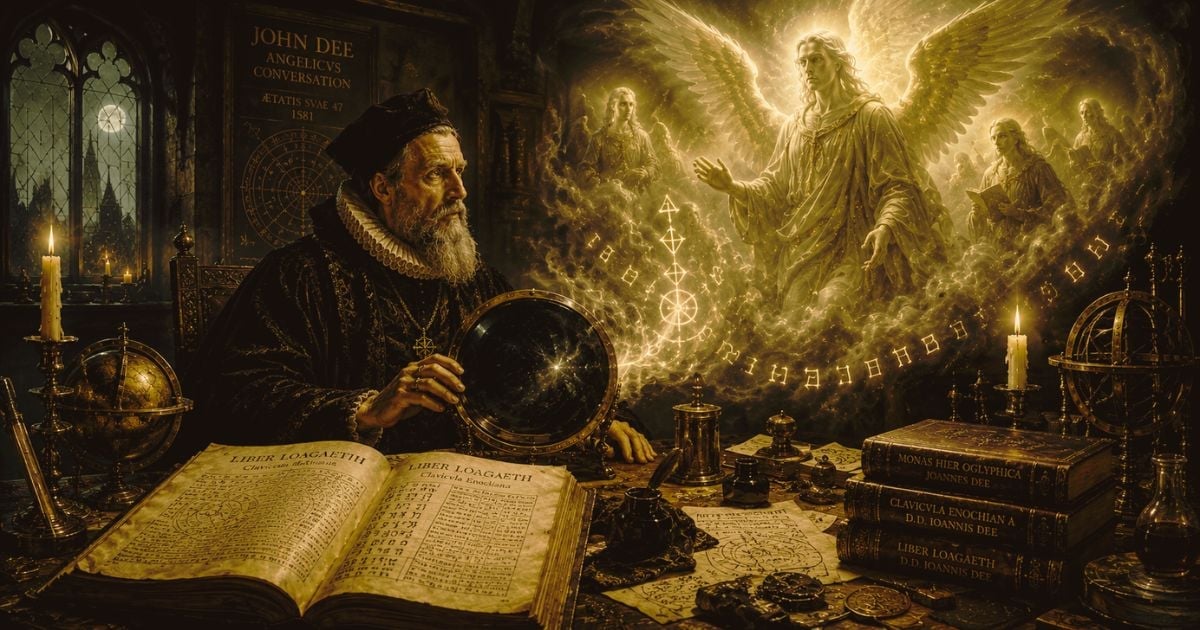
Here's what tends to get lost in the story of Dee and Kelley: Dee wasn't just collecting a language curiosity. He was receiving the architecture of a complete magical system. The forty-eight Keys were not poems. They were operational tools—invocations designed to open specific doors in the structure of reality and gain access to the intelligences and forces on the other side.
The system the angels delivered has several interlocking components, and understanding how they fit together matters.
At the foundation are the Watchtowers—four great tablets, each associated with one of the cardinal directions and one of the classical elements. East and Air. West and Water. North and Earth. South and Fire. Each Watchtower is a grid of Enochian letters, and those letters are not random. They encode the names of angels, governors, and divine forces arranged in a precise hierarchy. The Watchtowers are, essentially, a map of the celestial order—who governs what, which forces answer to which names, how the architecture of the divine is organized.
Above the Watchtowers, cosmologically speaking, are the Thirty Aethyrs—also called the Aires. These are realms or planes of existence arranged in ascending order, from the outermost and most accessible to the innermost and most rarified. The practitioner moves through them sequentially, using the Keys to open each one in turn, encountering the governors and intelligences of each Aethyr and receiving what they have to offer. Which is not always pleasant. Which is, in fact, often the opposite of pleasant.
The Keys themselves are the keys. Literally. Each one is an invocation in the Enochian language, and when spoken correctly—pronunciation matters, intent matters, preparation matters—they are understood to open the gates between the practitioner and the forces named.
Dee understood this. He was meticulous about it. His diaries record not just the content of the transmissions but the ritual conditions—the timing, the prayers, the tools required. The Holy Table of Practice. The Lamen he was instructed to wear hidden in white silk whenever he called upon the angels. The specific configurations of the working space. This was not casual dabbling. Dee understood that he was handling something that demanded to be handled correctly, and he treated it accordingly.
The system sat in his diaries for nearly three hundred years. And then the Victorians got hold of it.
It is the 1880s. London. The British Empire is at its peak, industrial modernity is in full swing, and a group of very serious men and women in a secret society called the Hermetic Order of the Golden Dawn are looking at Dee's diaries and thinking: we should do something with this.
The Golden Dawn was not a collection of credulous eccentrics. Among its members, at various points, were the poet W.B. Yeats, the novelist Arthur Machen, and the actress Florence Farr. Its founders—William Wynn Westcott and Samuel Liddell MacGregor Mathers—were genuine scholars of occult literature with serious academic chops. When they encountered the Enochian material, they recognized it for what it was: a coherent, sophisticated magical system that had been sitting largely untouched for three centuries, waiting.
Mathers and his collaborators did something ambitious. They took Dee's Enochian material and integrated it into the Golden Dawn's existing ceremonial magic framework. They systematized it, assigned the Watchtowers to the cardinal quarters of the ritual temple, developed protocols for working the Keys, and built the Enochian system into the higher grades of the Order's initiatory curriculum. By the time a Golden Dawn initiate reached the senior grades, they were expected to be conversant in Enochian magic as a living practice, not just a historical curiosity.
"The Enochian system has been in continuous use, in one form or another, for four hundred years. Systems that don't work tend not to survive that long."
This matters for two reasons.
First, it meant the system was no longer theoretical. People were actually working it. Actually speaking the Keys, actually invoking the Watchtowers, actually attempting to move through the Aethyrs. The results were reported, discussed, and compared. The Golden Dawn's internal documents on Enochian practice are extensive and, in places, deeply strange.
Second, it produced Aleister Crowley. Which is a consequence nobody fully thought through.
Crowley joined the Golden Dawn in 1898, rose quickly through the grades, got into an extended and extraordinarily petty feud with Mathers that resulted in, among other things, an alleged magical battle that I will not describe in detail here except to say that it apparently involved both men sending astral entities at each other across the English Channel. He was eventually expelled.
He then proceeded to become the most influential and most controversial figure in twentieth-century Western occultism, which is quite an achievement for someone who also managed to be almost universally disliked by people who met him in person.
For our purposes, what matters is what happened in 1909 in the Algerian desert.
Crowley, accompanied by his poet friend Victor Neuburg, spent several weeks in the desert conducting a systematic working through the thirty Enochian Aethyrs—all thirty of them, in sequence, from the outermost to the innermost. He spoke the Keys. He opened the Aethyrs. He documented everything in a text he titled The Vision and the Voice, and it is one of the most extraordinary and disturbing documents in the entire history of Western magic.
I want to be careful about how I describe this, because it is genuinely difficult to summarize without either making it sound like colorful drug-trip literature or making it sound more credible than I can responsibly claim. So I will just tell you what the record says and let you sit with it.
The outer Aethyrs were manageable. Strange, visionary, full of symbolic content that Crowley recorded in careful detail. The further in he went, the more intense the experiences became. The tenth Aethyr, ZAX, houses an entity called Choronzon—described in the Enochian material as the Dweller in the Abyss, a force of absolute dispersion and chaos that unmakes rather than creates.
"Crowley's working of ZAX involved Neuburg inside a protective circle while Crowley himself sat in a triangle outside it and invited Choronzon in. By Neuburg's account, what followed was terrifying."
Choronzon, speaking through Crowley, attempted to destroy the protective circle, threatened Neuburg, and had to be forcibly banished.
Crowley emerged from the ZAX working significantly changed. Whether you interpret that as the genuine psychological impact of an intense occult experience or as something more literal depends on your priors. What is not disputed is that he was not the same person on the other side of it.
The inner Aethyrs—the final ten—Crowley described as increasingly beyond language. The thirtieth Aethyr, LIL, the innermost, was apparently so intense that his account of it is barely coherent. He called the experience Union with God and also seemed to find it destabilizing in ways he never fully resolved.
Nobody has ever accused Crowley of lacking nerve. But the Aethyrs, by his own account, were something he did not fully control and could not fully survive intact.
I realize I've been speaking about the Enochian system as if you're already familiar with how it's laid out, and that's not fair. Let me give you the bones of it, briefly, in plain language.
The system operates on the understanding that reality is layered. The physical world is the outermost layer, the densest and least refined. Above it—or within it, depending on how you conceptualize the geometry—are realms of increasing subtlety and power, populated by intelligences that range from the angelic to the genuinely dangerous. The Watchtowers map the structure of the nearest layers. The Aethyrs map the structure further in, all the way to the divine source.
The forty-eight Keys are the operational tools for navigating this structure:
Each Aethyr has a name—a three-letter designator in Enochian—and a set of governors who rule it. Moving through the Aethyrs in sequence is understood to be a process of initiation, a progressive stripping away of the self as the practitioner moves toward the divine center.
The entities encountered in each Aethyr are not decorative. They test. They challenge. They offer things that come with costs. And the deeper you go, the less the normal rules seem to apply.
"This is not a system designed for beginners. This is a system designed for people who know exactly what they're doing and still manage to be surprised by the results."
And now, as I did in the language post, I have to pull back and show you the older picture. Because Enochian magic doesn't exist in isolation. It exists against a backdrop that, if you've read the Book of Enoch, you already know.
The angels who spoke to Dee through Kelley described the Enochian Keys as tools for navigating the divine structure—for moving through the layers of reality toward the source. Gabriel told Dee that the language was the original tongue of creation, the one that predated the Fall, the one that could move the creatures of God because it was the language in which they were made.
But the Book of Enoch gives us another set of divine beings who also knew things they shouldn't have taught to humanity. The Watchers who came down from Heaven and brought with them the hidden arts—enchantments, root-cutting, the secrets of the stars. The Watchers, who, in the text's framing, corrupted the world not through malice alone but through the reckless distribution of knowledge that humanity was not equipped to handle.
The Watchers are bound. We know that. Bound beneath the hills, in darkness, until the day of judgment.
But here is the question I keep turning over.
The Enochian system, at its deepest levels—the inner Aethyrs, the approach to the divine center—passes through an Abyss. Crowley called it ZAX. Choronzon lives there. The Dweller in the Abyss. The force of dispersion and chaos that unmakes. Every serious practitioner of the Enochian system who has pushed through to the inner Aethyrs has reported the Abyss as the critical test, the place where the self is destroyed or transformed, the threshold between the outer realms and the genuinely divine inner ones.
"What is on the other side of that Abyss? And more to the point—what is in it? What is Choronzon, really, and where did it come from?"
What if the Enochian system is not just a map of the divine? It is also a map of something that was lost and has not fully been accounted for. The Watchers brought knowledge down with them. The Nephilim carried it, twisted and amplified, into the antediluvian world. The flood came and supposedly buried it all.
But knowledge doesn't drown. It waits.
And a system that claims to be the original language of angels, transmitted through a polished stone to a con man and a genius in Elizabethan England, that then spent three centuries dormant before being resurrected by a Victorian secret society and then taken into an Algerian desert by the most reckless magician of the twentieth century—that system carries a history. A long one. And not all of it is divine, in the way we usually use that word.
I should tell you that Crowley was not the end of the story. Not even close.
The twentieth century produced a remarkable number of serious Enochian practitioners. Israel Regardie, who published the Golden Dawn's secret documents and made the Enochian system widely available for the first time, spent decades working with it and writing about it. His accounts are careful and technically detailed and occasionally alarmed in ways that he seems to have found difficult to fully articulate.
Anton LaVey incorporated elements of the Enochian Keys into the Satanic Bible in 1969, which introduced them to a much wider audience and horrified serious practitioners who felt he was handing live ammunition to people with no idea what they were holding.
Contemporary ceremonial magicians work the system today—actively, carefully, with extensive preparation protocols and extensive debriefs afterward. The online communities dedicated to serious Enochian practice are not casual places. The people in them are not larping. They are documenting experiences that follow consistent patterns across practitioners who have never met, reporting encounters with the Aethyr governors that match Crowley's accounts with an accuracy that is difficult to explain as coincidence or shared delusion.
What that means is a question each person has to answer for themselves.
What I will say is this: the system has been in continuous use, in one form or another, for four hundred years. That is a long time. Systems that don't work tend not to survive that long. And systems that work—in magic as in everything else—work for a reason. The question is whether you understand the reason well enough to be comfortable with what you're actually doing.
"Dee understood it, as well as any human being ever has. It still consumed the last years of his life. Crowley understood it better than almost anyone who came after him. The Abyss still took a piece of him he never got back."
I find that clarifying rather than discouraging. Not every door is meant to be opened. Some of them were sealed for good reasons by people—or things—who knew exactly what they were sealing away. The Enochian system is a set of keys. The clue is right there in what they're called.
The question worth asking, before you use a key, is whether you're ready for whatever is on the other side of the door.
The Enochian magical system is not a historical artifact. It is a living practice, documented across four centuries, producing consistent results in the hands of practitioners who approach it with the seriousness it demands. It is also, by its own account, the operational magic of the original angelic order—the technology, if you want to call it that, by which the divine structure of reality is navigated and engaged.
If that's true, it raises questions that the history of the system has not answered and that I suspect cannot be answered from the outside.
What exactly did Dee and Kelley receive? Was Kelley transmitting, or was he a channel for something that had been waiting for the right conditions to surface? Why did the angels choose that particular moment—Elizabethan England, a crystal ball, an unlikely partnership—to deliver a system they claimed had been sealed since the Fall?
And the question underneath all the others, the one that lives in the dark foundation of everything I've been writing in this blog: if the Watchers brought knowledge down from Heaven before the flood, and if the flood was meant to bury it—why does it keep coming back?
"The forty-eight Keys are still out there. The Aethyrs are still there. The Abyss is still there, with whatever lives in it. And somewhere beneath the hills, in the darkness that the Book of Enoch describes, something is still waiting for the day of judgment. If you believe in such things."
Steve Gilmore is the author of the Heaven's Dark Soldiers urban fantasy series. The Enochian magical system, the Watchers, and the question of what ancient things might still be waiting—these are not purely academic interests.
Seven books of urban fantasy where soldiers become angels, angels become monsters, and the only thing worse than what's coming... is what's already here.
Explore all Mischief & Lore posts on ancient texts, supernatural lore, forbidden knowledge, and the strange ideas that shape Steve's worlds.
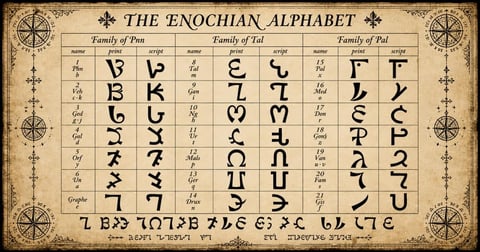
John Dee, Edward Kelley, and the angels' forbidden tongue—plus what it means that it keeps surfacing.
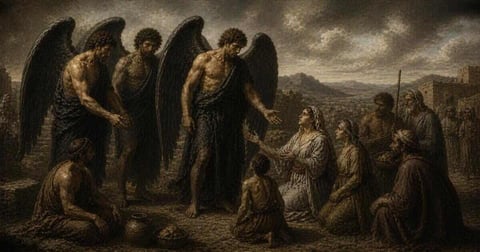
The Watchers came down from Heaven with forbidden knowledge—and changed everything.
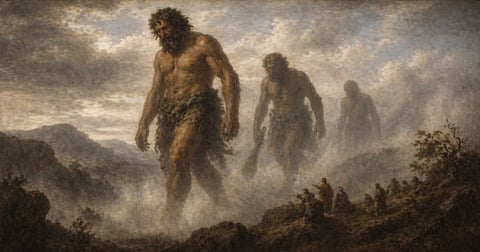
The Nephilim, divine judgment, and the flood. The story that changed everything.
If the ancient secrets and supernatural horrors of Enochian magic have you hooked, imagine what happens when a West Point dropout discovers the angels have been lying for centuries.