Mystical study room with open ancient book, skull, candles, astrolabe, and gothic window with light streaming through panes
Lore

The Book of Enoch: When Smart Angels Do Dumb Things

(Part 1)

Ancient watchers. Forbidden knowledge. Catastrophic decisions.

Turns out celestial beings can make terrible choices too.

Steve Gilmore May 1, 2026 Lore
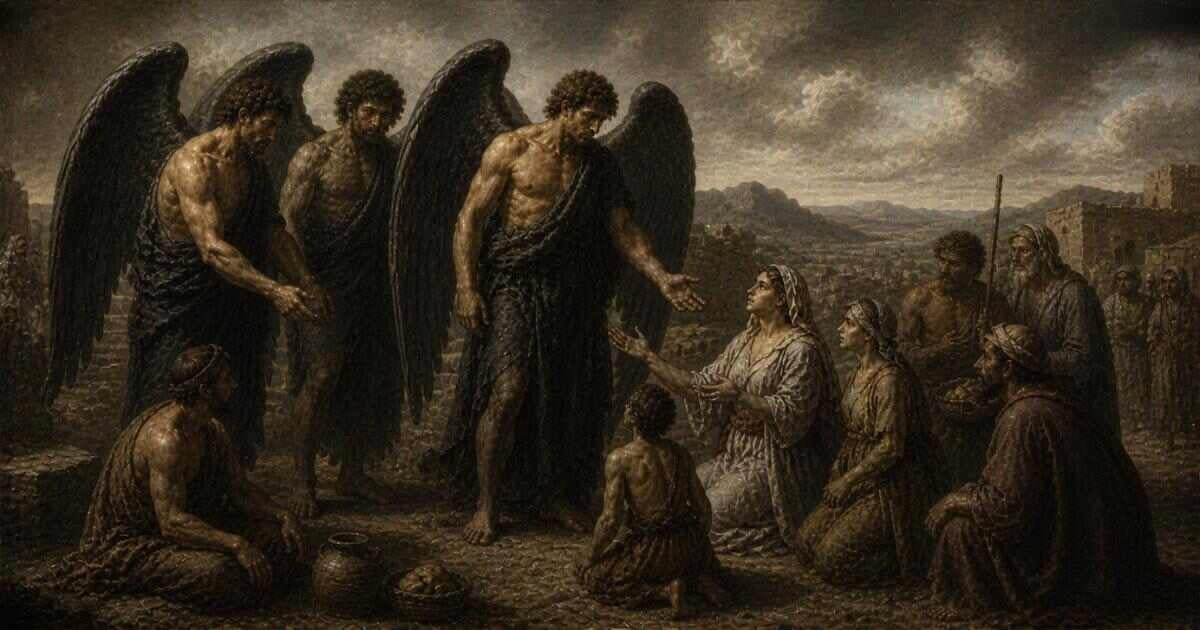
Dark religious painting depicting angels with dark wings gathered around kneeling figures in a medieval landscape

Ancient scrolls and texts — the kind that got left out of the official canon

Let me tell you something about angels.

Most people picture them as these soft, glowing, harp-strumming creatures who exist exclusively to deliver good news and look decorative. All light and grace and divine purpose. The celestial equivalent of a Hallmark card.

And then you read the Book of Enoch.

And you realize — oh. Oh. Some of them were complete and total idiots.

"Some of them were complete and total idiots."

— Steve Gilmore

I'm not being glib here, for once. This is genuinely one of the most remarkable documents in the entire ancient world, and it doesn't get nearly the attention it deserves, because somewhere along the way, somebody decided to leave it out of the Bible. Which, honestly, is a shame. Because the story it tells is one of the most jaw-dropping, consequence-riddled, "what in the actual hell were you thinking" narratives you will ever encounter.

Buckle up. We're going in.

Section One

First — What Even Is the Book of Enoch?

Right. Quick orientation, because this matters.

Enoch is a name that appears briefly in Genesis. He's Noah's great-grandfather. The Bible tells us, almost in passing, that Enoch "walked with God" and then — instead of dying like a normal person — God simply took him. He just... wasn't anymore. Which is the kind of sentence that deserves a lot more follow-up than the Bible gives it, but that's a conversation for another day.

What the Book of Enoch is, is a much more detailed account of what Enoch actually saw and experienced during his time with the Watchers — a class of divine beings assigned to observe and assist humanity. The earliest surviving fragments of the book date back to around 300 BCE, though scholars believe it was written even earlier. It was widely read and studied in the ancient world. It's quoted in the New Testament letter of Jude. It was revered by the early church.

And then it largely vanished from Western canon.

The Ethiopic Church kept it. The Ethiopian Orthodox tradition preserved the complete text while the rest of the world apparently moved on. The version most scholars work from today is based on Ethiopian manuscripts, and the translation I've spent time with is Andy McCracken's modern English rendering based on Michael Knibb's scholarly Ethiopic translation.

So when people tell you Enoch is fringe material — well-meaning but misguided. This thing was scripture to a lot of people for a very long time. It just didn't make the final editorial cut. Which, again — shame.

Now. On to the part where divine beings make catastrophically bad decisions.

Section Two

The Watchers: A Primer on Celestial Stupidity

Here's the setup: There exists, according to Enoch, a category of divine beings known as the Watchers. Their job is exactly what the name implies — they watch. They observe humanity. They presumably take notes, mind the store, and generally do the whole divine oversight thing with appropriate professionalism and restraint.

Two hundred of them apparently decided that professionalism was overrated.

"Two hundred of them apparently decided that professionalism was overrated."

— Steve Gilmore

The text is blunt about what happened. Enoch writes, in what has to be the most matter-of-fact description of a cosmic catastrophe in ancient literature, that these Watchers looked down from their heavenly vantage point, noticed that the daughters of men were beautiful, and collectively decided they wanted in on that.

Now, I want to pause here for a second. Because we're talking about beings of divine origin. Celestial. Eternal. Presumably possessed of an awareness of consequence that should far exceed anything the average human manages on their best day.

"Yeah. This seems fine. Let's do this."

— The Watchers (Probably)

Their leader is named Semyaza, and — credit where it's due — even he seemed to have some awareness that this was an incredibly bad idea. He said as much to the group. He told them that if they went through with this plan, the sin would be on him alone, and he'd bear that. The group's response was essentially: No, no. We'll all be idiots together. Swear an oath. Mount Hermon. Let's go.

Mount Hermon, by the way, gets its name from the Hebrew word for "curses." I'll just leave that sitting there.

The descent happened. Two hundred Watchers came down to Earth and took human wives. And their names — Semyaza, Azazel, Armaros, Baraqel, Kokabel, Tamiel, Ramiel, and a whole roster of others — get listed out in Enoch with the kind of specificity that suggests these were not mythological constructs. These were understood to be actual individuals whose actual names someone wanted on record.

For reasons that will shortly become obvious.

Section Three

What the Watchers Brought With Them

Here's where it gets complicated. And by "complicated," I mean "here's where the gift-giving starts to look a lot like a problem in retrospect."

The Watchers didn't just come down and take wives and call it a day. They taught things. They shared knowledge. The text catalogs it in a way that reads less like a blessing and more like a damage assessment after the fact.

Azazel

Taught swords, knives, shields, body armor, cosmetics, jewelry, and beautification arts

Semyaza

Taught enchantments and root-cutting

Armaros

Taught the resolving of enchantments

Baraqel

Taught astrology

Kokabel

Taught the constellations

Tamiel

Taught astronomy

Enoch's accounting of this knowledge-transfer is not celebratory. The text treats it as corruption. The idea seems to be that humanity wasn't ready for these things — that the tools of warfare and vanity and secret arts poured into a young civilization before its time created a particular kind of rot. Violence spread. The Earth, as the text puts it, cried out from the wickedness that arose.

Now, I'm not going to tell you how to feel about the theology of that. Smart people have argued about it for centuries.

What I will say is that the framing is consistent: the Watchers brought things they weren't authorized to bring, to people who weren't equipped to receive them, and the results were catastrophic. That part is pretty clear.

Enjoying the Chaos?

If mythology, supernatural warfare, ancient powers, forbidden knowledge, and dark humor are your thing, explore the worlds of Steve Gilmore.

The Story Continues...

This is just the beginning. The Book of Enoch goes much deeper into what happened to the Watchers, the consequences of their actions, and the cosmic reckoning that followed. If you've been enjoying this chaos, there's much more to explore in the ancient texts.

Fans of supernatural warfare in Heaven's Dark Soldiers will recognize the echoes of these celestial dynamics — angels making questionable choices, divine hierarchies in conflict, and the messy aftermath of beings who should know better doing exactly what they shouldn't.

Readers who enjoy the metaphysical chaos of Purgatory Knights will find similar themes of forbidden knowledge and unintended consequences running through those stories as well.

Steve Gilmore draws heavily from these ancient traditions, weaving real mythological source material into his urban fantasy worlds. The Book of Enoch is just one of many texts that have influenced his storytelling.

Stay tuned for future lore posts where we'll dive deeper into the Watchers' fate, the Nephilim, and what all of this means for the mythology that followed. Join the Inner Circle for future lore breakdowns and exclusive content.

Keep Reading

MORE MISCHIEF & LORE

Explore more articles from the ancient texts of Steve Gilmore's imagination.

THE STORY GETS STRANGER FROM HERE

The deeper you go into ancient lore, forbidden knowledge, and supernatural history…

The weirder things get.

Fortunately, that's where the fun starts.