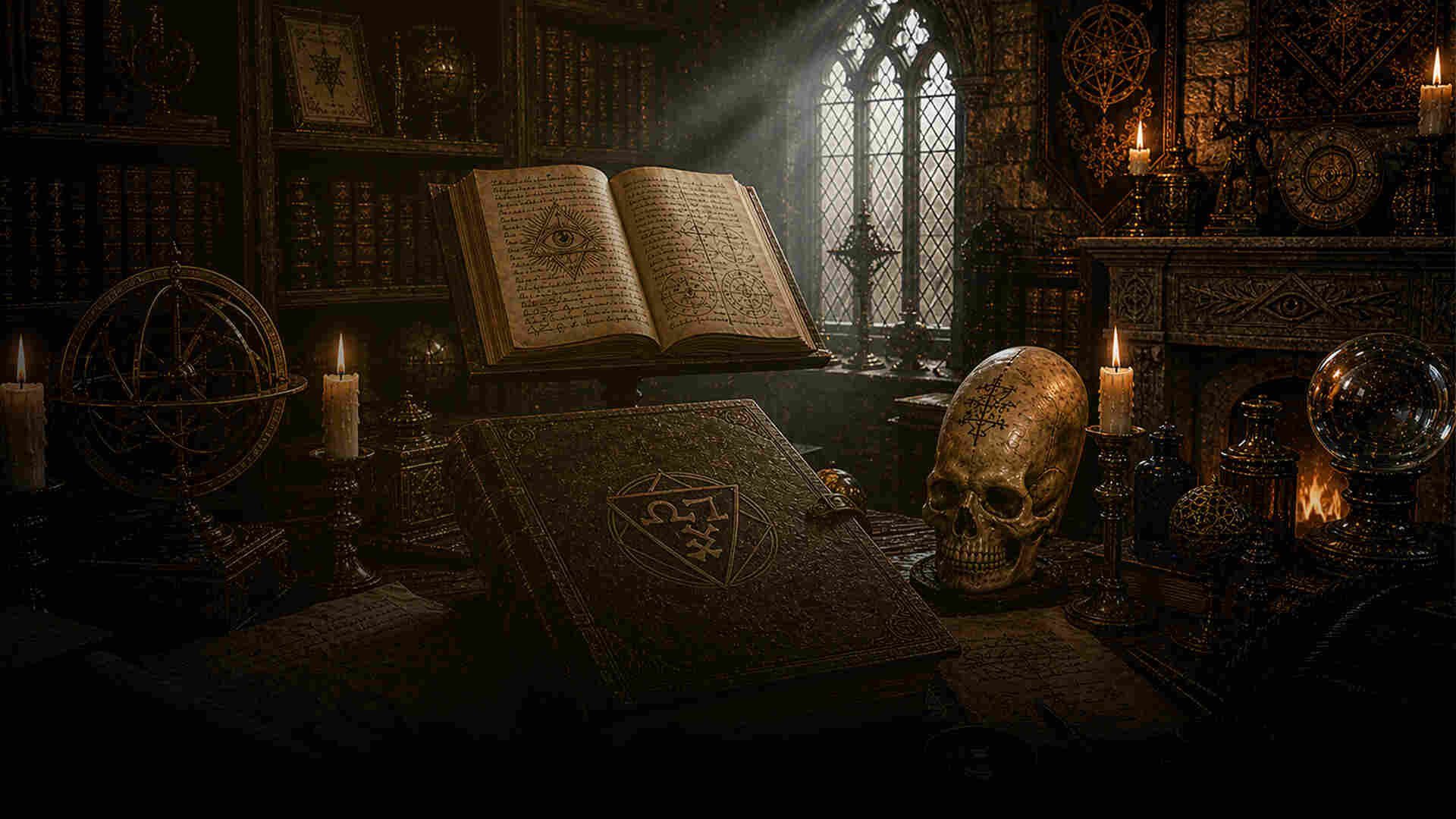
John Dee, Edward Kelley, and the Angels' Forbidden Tongue
John Dee. Edward Kelley. A crystal ball. And a language that supposedly hadn't been spoken since Eden.
The question of what it actually is has never been satisfactorily answered.
The Watchers brought forbidden knowledge to humanity — including, perhaps, the language of creation itself
Let me introduce you to two men.
The first is Dr. John Dee. Mathematician. Astronomer. Cartographer. Adviser to Queen Elizabeth I. One of the most brilliant minds of the Elizabethan age, a man so accomplished that he helped design the navigational systems that powered England's Age of Exploration. He owned one of the largest private libraries in England. He was, by any reasonable measure, a serious person.
The second is Edward Kelley. Con man. Forger. A man who, depending on which historical account you read, had his ears cropped as punishment for fraud before he ever met Dee. He arrived on Dee's doorstep in 1582 claiming to be a medium—a scryer—someone who could peer into a crystal ball and receive communications from the other side.
And here is the thing that should stop you cold: Dee, the genius, believed him.
Not only believed him. Dedicated years of his life to sitting across a table from Kelley, watching him stare into a polished obsidian mirror or a crystal "shewstone," and meticulously transcribing everything Kelley claimed the angels were saying.
What came out of those sessions was one of the most extraordinary and genuinely unsettling bodies of material in the history of Western occultism. A complete magical system. A cosmology. Forty-eight cryptic calls or keys, written in a language that neither man had spoken before. A language the angels—through Kelley—identified as the original tongue of creation itself.
They called it the Angelic language. We call it Enochian.
And the question of what it actually is has never been satisfactorily answered. If you believe in such things, that is.
The sessions began in earnest in 1582 and ran, with interruptions, for several years. Dee kept exhaustive diaries of everything—the dates, the circumstances, the content of the transmissions, his own reactions and doubts. Those diaries survive. Meric Casaubon published a large portion of them in 1659 under the title A True and Faithful Relation of What Passed for So Many Years Between Dr. John Dee and Some Spirits, which is either the most credulous title in publishing history or the most admirably straightforward one, depending on your disposition.
The process worked roughly like this. Dee would prepare the space—proper timing mattered, astrological forces had to be favorable, prayers were said. Kelley would position himself before the crystal and enter his receptive state. The angels would appear, and Kelley would describe what he saw and heard. Dee would write it all down.
The Archangel Uriel showed up. Gabriel showed up. An entity called Ave showed up with some regularity. And they had a lot to say.
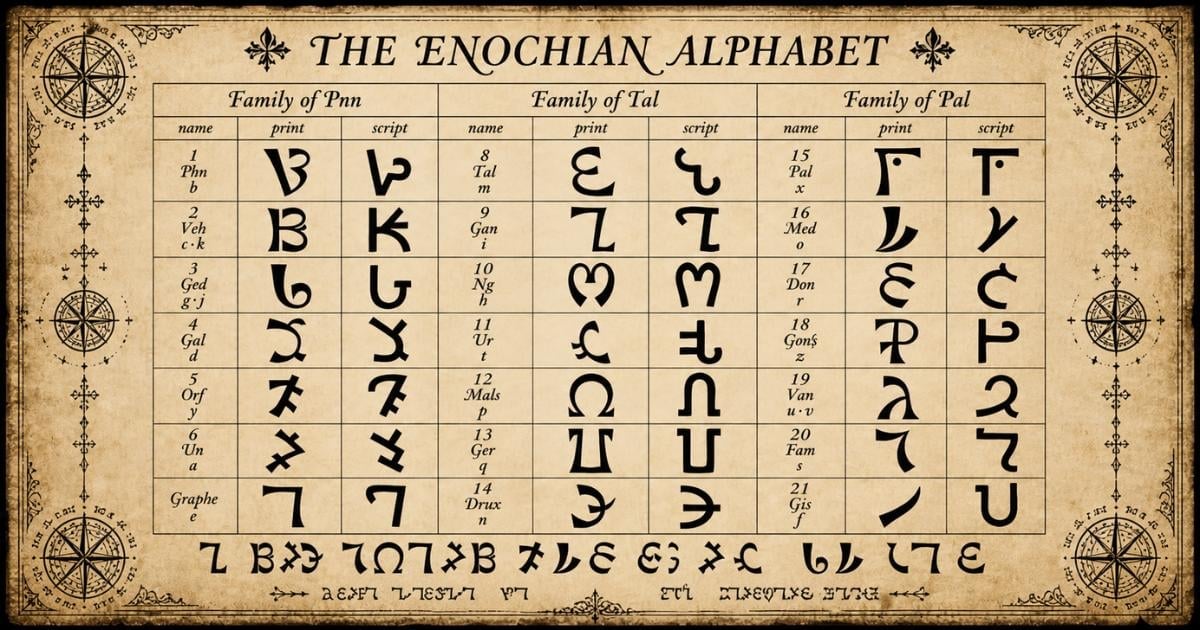
The Angelic language itself was delivered with painstaking specificity. The alphabet—twenty-one letters, arranged in three families of seven—was shown to Kelley on May 6th, 1583, appearing directly upon a page in his journal in what he described as a golden, or yellow, color. He traced the characters before the impression faded. The letter names were given: Pn, Vah, Ged, Gal, Or, Un, Graph, Tal, Gon, Na, Ur, Mals, Ger, Drux, Pal, Med, Don, Ceph, Van, Fam, Gisg. Twenty-one letters. Three families. The mystical number pattern was not, the angels made clear, accidental.
The actual text of the transmission—the Liber Logaeth, or Book of the Speech from God—was delivered even earlier, beginning March 26th, 1583. Dee described it as being "all full of squares," written in a completely alien tongue. The Archangel Raphael began transmitting the text by naming each character one by one. This was, apparently, as tedious as it sounds. Dee eventually asked if Roman characters could be substituted to speed things up. The angels, after what one imagines was a moment of celestial irritation, grudgingly consented. The original Angelic script largely disappeared from the record after that, leaving us with transliterations into the Roman alphabet.
The forty-eight Angelic Keys—the calls or invocations at the heart of the system—came later, and they are something else entirely. They read as apocalyptic, prophetic, concerned with final judgment and the structures of divine power. Whatever you think of their origin, they are not the kind of thing you dash off on a Tuesday afternoon. There is a weight to them that is difficult to dismiss even if you approach the whole enterprise with maximum skepticism.
Here is where it gets genuinely interesting, and where I start paying very close attention.
The Archangel Gabriel, speaking through Kelley on April 21st, 1583, described the Angelic language this way. I'm going to quote this at some length, because the angels apparently had strong opinions about it and I don't want to shortchange them:
"Man in his Creation, being made an Innocent, was also authorized and made partaker of the Power and Spirit of God: whereby he not only did know all things under his Creation and spoke of them properly, naming them as they were: but also was partaker of our presence and society, yea a speaker of the mysteries of God; yea, with God himself: so that in innocency the power of his partakers with God, and us his good Angels, was exalted."
The argument Gabriel is making is this: the Angelic language is not a language that was invented. It is the original language—the language of Eden, the language in which the act of naming was an act of creating. Hebrew, Gabriel notes with what sounds like mild condescension, is not of that force. Hebrew is a later approximation. This is the real thing, and it has not been disclosed to man since the Fall—until now, until these sessions, until Dee and Kelley.
The language, Gabriel explains, operates on a fundamental level. When the creatures of God hear the words with which they were "nursed and brought forth," they respond. They move. It is a language of creative force, not merely of communication. Each letter, each word, contains within it an essence of the substance it describes.
This is not, to put it mildly, a modest claim.
And yet scholars who have examined the Enochian material seriously—not as believers, just as linguists and historians—note that the language does appear to have internal consistency. It has what looks like a root system. It has grammatical forms. It has a vocabulary that behaves in predictable ways within the corpus. It is, in the technical sense, language-like in ways that invented gibberish usually is not. This doesn't prove anything. But it is interesting. And I find interesting things interesting.
Now. Here's what Gabriel didn't mention, at least not explicitly. Or perhaps he assumed Dee already knew.
The language of angels has a history that predates John Dee by several thousand years. And if you've been following this blog—if you've read my posts on the Book of Enoch—you already know where this is going.
The Watchers were divine beings. Two hundred of them, assigned to observe humanity, who descended to Earth and made choices they were never going to be able to walk back. They taught humanity things that weren't meant to be taught. Enchantments. The secret arts. The hidden knowledge of the cosmos.
They would, by definition, have spoken the Angelic language. The original tongue. The language of creation that Gabriel describes to Dee—the language Adam spoke in Eden—would have been the native language of the Watchers themselves. When they came down from Hermon and walked among humanity, that is what they would have carried with them. Not just knowledge of weapons and root-cutting and the movement of stars. But the language in which all of those things were named, and in the naming, made real.
The Book of Enoch doesn't frame it quite this way. It doesn't use the words "Enochian"—that's a much later label, and somewhat ironic given that Enoch himself was the one human being who walked with the divine and came back to tell the story. But the implication is there, running underneath the text like a current. The Watchers brought things with them. They taught things they shouldn't have taught. And language—real language, language as power, language as creation—would have been the deepest thing they carried.
Gabriel tells Dee in 1583 that this language has not been disclosed to humanity since the Fall. Since Adam lost his innocence and the original tongue went with it.
That is one way to read the history.
Another way is to look at Mount Hermon. At the two hundred who made their oath there. At the knowledge they poured into a civilization that wasn't ready for it. And ask yourself: what if Gabriel was being somewhat selective about the chain of transmission?
What if the Angelic language didn't go silent after Eden?
What if it was carried, broken and imperfect and dangerous, in pieces, through the long catastrophic history the Book of Enoch describes? Scattered into fragments by the flood, buried in texts and traditions, surfacing occasionally in forms that the people who encountered it barely recognized? And what if John Dee, brilliant and desperate and trusting exactly the wrong partner, somehow managed to reach far enough into that darkness to pull some of it back?
I'm not saying that's what happened.
I'm saying that's a better story than the alternative.
I can't leave you with pure mysticism without acknowledging the obvious.
Edward Kelley is a problem.
The man had a documented history of fraud before he ever sat down with Dee's crystal. There are serious historians who argue that the entire Enochian system was an elaborate con—that Kelley was making it up as he went, feeding Dee exactly what Dee wanted to hear, and that Dee's genius made him more susceptible to this kind of manipulation rather than less, because he was capable of building elaborate theological and mathematical frameworks around whatever raw material Kelley supplied.
This is a fair argument. I'm not going to pretend it isn't.
But here is the counter-argument, and it's one I find genuinely difficult to shake: the material is too consistent, too strange, and too cohesive to be casual invention. Kelley was not a scholar. He was not a linguist. The forty-eight Keys have a grammatical and structural regularity that takes years of study to fully unpack. The cosmological system embedded in the transmissions is internally coherent in ways that would be extraordinarily difficult to fake in real-time, session after session, under the scrutiny of one of the sharpest minds in Elizabethan England.
Either Kelley was a savant of a very peculiar kind, or something was actually happening in that room.
The honest answer is: we don't know. We have Dee's diaries. We have the Keys. We have centuries of practitioners who have worked with the Enochian system and reported results that range from the profound to the terrifying. We have a language that appears to function, linguistically, like a language. And we have the uncomfortable fact that its claimed origin—the original tongue of angels, the language Adam spoke in Paradise—lines up rather precisely with what the older texts describe.
That's enough to keep me thinking about it. Which is, I suspect, the point.
I should tell you what Enochian actually sounds like, because that matters.
The forty-eight Keys are not silent texts. They were meant to be spoken, and practitioners who have done so describe the experience as distinctly unsettling in a way that is difficult to attribute to placebo alone. The phonology of the language—the sounds themselves—has a quality that sits in the ear differently than English or Latin or Hebrew. There is something in the vowel combinations and consonant clusters that feels, for lack of a better word, old.
The first Key begins: "Ol sonuf vaorsagi gohu Iad Balata."
The angels told Dee it meant: "I reign over ye, saith the God of Justice."
Say it out loud. Just try it. And tell me that doesn't sound like something that was waiting to be spoken again.
John Dee died in 1608 or 1609—the exact date is uncertain, which feels appropriate. He died in relative poverty, his reputation largely in tatters, having spent decades pursuing a conversation with angels that most of his contemporaries considered at best eccentric and at worst diabolical. Kelley had died years earlier, in 1597 or 1598, reportedly trying to escape from a tower prison in Bohemia, injuries sustained in the fall finishing him off.
Their partnership was, by any practical measure, a disaster. It ended their friendship, damaged their families, and produced a body of material that spent the next two centuries sitting largely unexamined.
And then the occultists found it. The Golden Dawn in the late 1800s. Aleister Crowley. Serious practitioners and serious scholars who looked at what Dee and Kelley had produced and recognized that whatever it was, it wasn't nothing. The Enochian system became one of the most studied and practiced systems in Western ceremonial magic. It's used today, actively, by practitioners around the world.
The language did not stay buried.
Which brings me back to the question I keep returning to, the one that lives at the center of my novels and, increasingly, at the center of this blog.
If Enochian is the original language of angels—the tongue of Eden, the speech of the Watchers, the words with which creation was named and therefore made—then what does it mean that it keeps surfacing? That it refuses to stay silent?
The Watchers are bound. The Book of Enoch is clear about that. Bound beneath the hills, in darkness, until the day of judgment. But bound isn't the same as gone. And language is a funny thing. It doesn't need its speakers to survive. It travels in fragments. In texts. In the mouths of con men who somehow, in the middle of an Elizabethan parlor trick, found themselves transmitting something they didn't understand.
It travels in the dark places, waiting for someone who knows how to listen.
I'd be careful about being that person.
But I'd also be lying if I said the idea didn't fascinate me completely.
If this has piqued your interest, here's where to dig deeper:
Elizabeth I's court magician, advisor, and possibly the most dangerous man in England. His diaries and recorded conversations with angels remain endlessly fascinating.
Brilliant, controversial, and completely impossible to ignore.
The late 1800s magical order that took Dee's Enochian system seriously—and produced some of the most influential occultists of the 20th century.
Aleister Crowley came from this lineage. Need I say more?
Con man, possibly fraudulent medium, possibly genuine channel for angelic speech. The academic consensus has shifted multiple times on which he was.
Either way, the words came through him. That's what matters.
And if you want to see what happens when these ancient words and the beings who spoke them collide with the modern world—
Well, that's what the Heaven's Dark Soldiers series is for.
Angels, fallen and otherwise. Ancient languages with modern consequences.
Explore Heaven's Dark SoldiersSteve Gilmore is the author of the Heaven's Dark Soldiers urban fantasy series. The Enochian language, the Watchers, and the question of what ancient things might still be speaking—these are not purely academic interests.