The Nephilim, Divine Judgment, and the Flood
Two hundred angels. Forbidden children. Cosmic consequences.
When human intervention stopped being enough.
The Watchers gather — angels who looked at humanity and saw something worth breaking the rules for
Welcome back to Mischief and Lore.
If you missed my previous post, The Book of Enoch (Part 1), here's the short version: two hundred angels called the Watchers descended to Earth, took human wives, and proceeded to share knowledge humanity had absolutely no business having—weapons, enchantments, the secret arts. All in flagrant violation of their celestial mandate.
And I said at the end of that post that things were about to escalate.
Well, I might've undersold it.
Because the Watchers' forbidden unions produced offspring. And those offspring—the Nephilim—turned out to be a problem of a magnitude that makes everything that came before look like a minor policy disagreement. This is where the Book of Enoch stops being a cautionary tale about bad decisions and becomes something closer to a disaster chronicle.
Fun, right?
Let's get into it.
The real escalation comes when the Watchers' children start showing up.
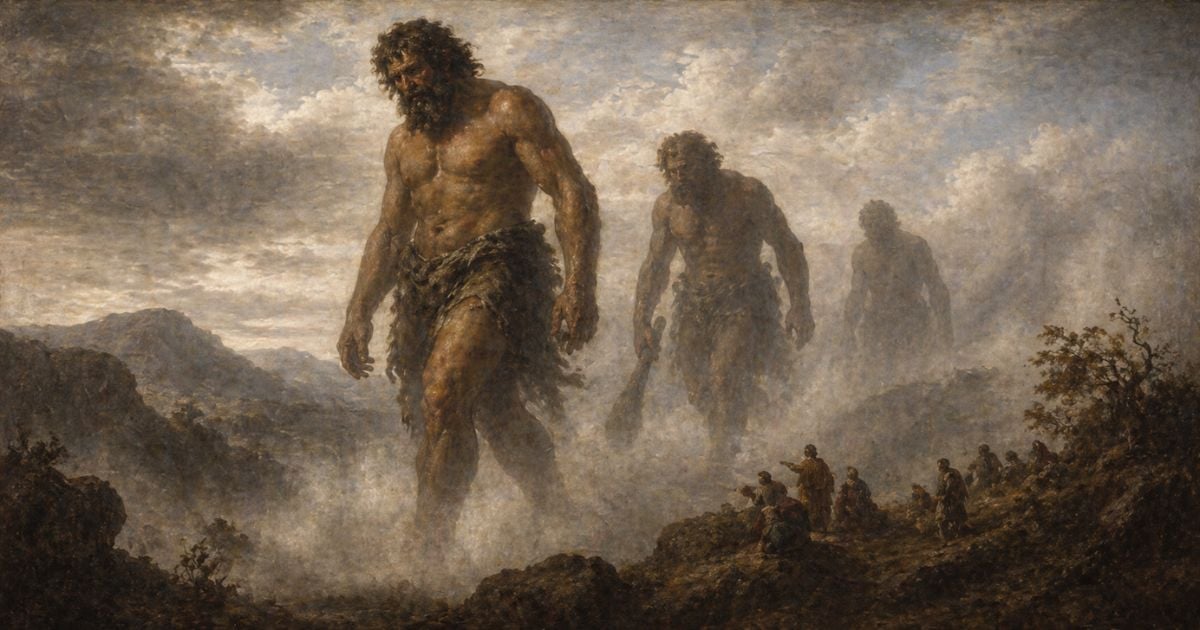
The wives of the Watchers bore sons. The text calls them giants—Nephilim, in Hebrew, a word that carries the sense of "those who fell" or "those who swoop down." Enoch describes them as consuming everything in sight. First the food stores ran out. Then the giants turned on the animals. Then, in a detail that is as bleak as anything in the ancient world, they turned on humanity.
The Earth was being eaten alive by the children of divine beings who had abandoned their post.
The Book of Enoch is not subtle about the scale of this disaster. The text makes clear that these weren't just large men who were a bit aggressive. These were beings of mixed divine and human origin, with appetites that could not be satisfied and power that could not be checked by any ordinary means. The supernatural parentage meant the rules that governed mortal conflict didn't quite apply.
And then there's the secondary problem.
The Watchers themselves, emboldened and apparently not yet grasping the magnitude of what they'd set in motion, also began to sin against birds, beasts, reptiles, and fish—taking whatever they wanted from the natural world. The corruption spread in every direction simultaneously:
Here's the moment in Enoch that hits me every time I read it: The souls of the dead—the people killed, the ones consumed, the ones who had no recourse and no hope—their cry goes up to Heaven. The text says the Earth itself accused the lawless ones. And the archangels took note.
Michael, Gabriel, Saraqael, Uriel—they stood before God and reported what had happened. The world was full of blood and unrighteousness. The Watchers had revealed eternal secrets to the wrong people. The Nephilim were consuming the earth. The women who had been with the Watchers were crying out.
What follows is a response that is, depending on your perspective, either perfectly calibrated divine justice or a demonstration of what happens when things have gotten so thoroughly out of hand that only cosmic intervention can address it.
God's response to the four angels is direct and kind of brutal: Bind the Watchers. Not forever—not yet—but until the day of judgment. The text is specific about this. They are bound beneath the hills, beneath the desert places, in fire and darkness, until the great accounting.
The giants—their offspring—are not spared by virtue of their parentage. The instruction is clear: let them destroy each other. Let the Nephilim fall by their own hands. And then address what comes after.
And that would be the flood, for those keeping score.
I want to dwell on Azazel for a moment, because his sentence is specific and evocative in a way that stuck with me.
Raphael is dispatched to deal with him personally. The instruction reads:
Bind Azazel hand and foot and throw him into the darkness. And make an opening in the desert—which is in Dudael—and put him in it. And put rough and jagged rocks under him, and cover him with darkness, and let him stay there forever. And cover his face so that he cannot see the light.
And then, on the Day of Judgment, Azazel is to be thrown into the fire.
The text attributes to Azazel specifically the charge that he revealed eternal secrets—the knowledge of weapons, the arts of war, the seductions that led humanity astray. The punishment fits the crime in a specific way: the being who taught humanity to see things it shouldn't see is sealed in a place of perfect darkness, face covered, unable to see anything at all.
There's a poetry to that I find genuinely chilling.
Look, I write urban fantasy novels. My bread and butter is taking ancient mythological and supernatural frameworks and asking—sincerely, without mockery—what if this was real? What if these things actually happened? What would the consequences look like thousands of years later?
And the Book of Enoch, for me, has always been the foundational document for that exercise.
Because what Enoch describes isn't just a curiosity. It's a cosmology with specific names, specific crimes, specific punishments, and specific unresolved consequences:
The ripples of that event, if you take the framework seriously, are still moving.
The thing about the Book of Enoch that gets under your skin isn't the supernatural scale of it. It's the intimacy of it.
Two hundred divine beings stood on a mountain and made a choice. They looked at the world below them and decided to cross a line they knew they weren't supposed to cross. And the cost was incalculable. The Earth bled. The heavens were scandalized. God himself had to intervene in the most catastrophic way imaginable.
All because two hundred beings who should have known better looked at something they wanted and decided the rules were someone else's problem.
I don't know. Maybe that's not so hard to understand after all.
If this has piqued your interest, here's where to dig deeper:
Andy McCracken's modern English translation is accessible and well-annotated. Michael Knibb's scholarly Oxford translation is the gold standard if you want academic rigor.
Both are worth your time.
The canonical Bible passage is brief—almost jarringly so—but it's there. Sons of God. Daughters of men. Giants.
The Book of Enoch is essentially the extended director's cut of that footnote.
Fragments of the Book of Enoch were found among the Scrolls, which should give you some sense of how widely it was circulated.
This was serious stuff in the centuries around the time of Jesus.
And if you want to see how I've thought about what a world shaped by these events might actually look like—
Well, that's what the Heaven's Dark Soldiers series is for.
Kinda sorta, anyway.
Explore Heaven's Dark Soldiers