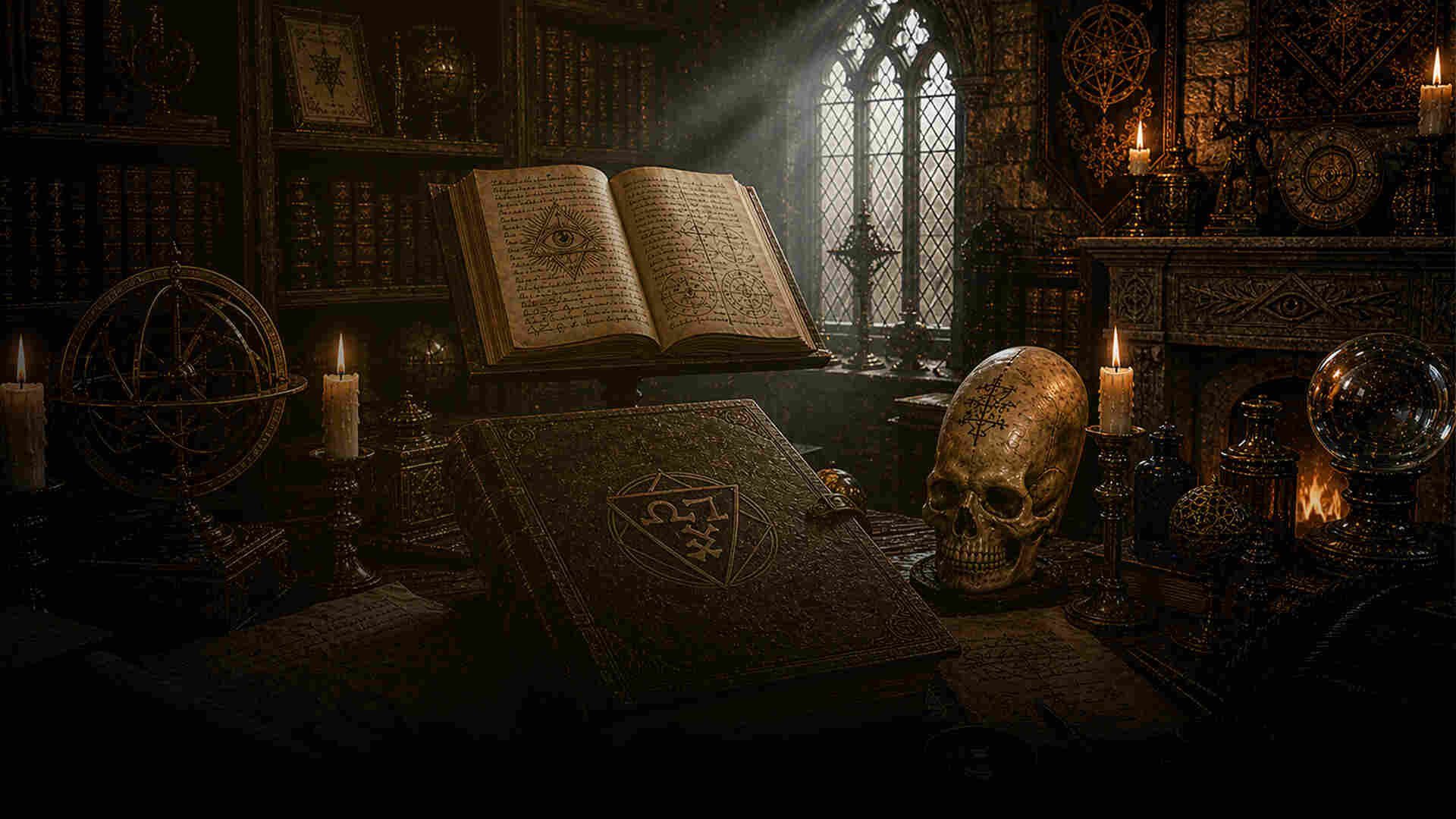
The Most Dangerous Object in History — and Nobody Knows Where It Is
King Solomon. The wisest man who ever lived. Given dominion over demons, djinn, and angels alike.
And then he lost it all for love.
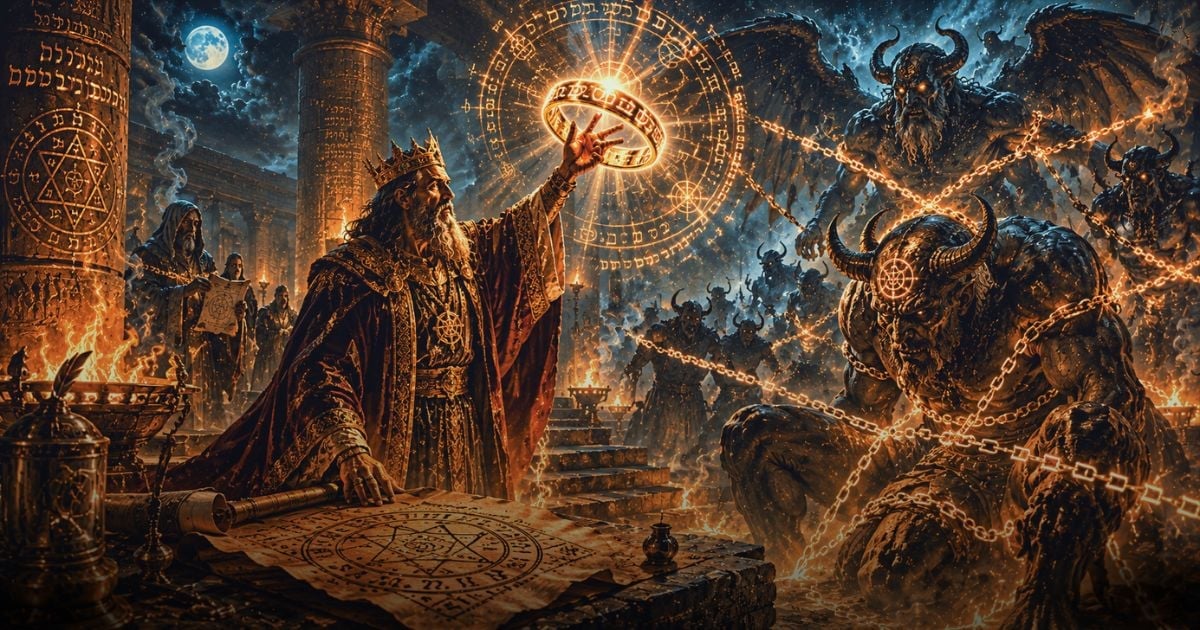
The Seal of Solomon — said to bear the Greatest Name of God, granting dominion over all supernatural beings
Let me tell you about the wisest man who ever lived.
King Solomon. Son of David. Third king of Israel. The man to whom God appeared in a dream and said, essentially, name what you want and it's yours. Solomon could have asked for wealth, for long life, for the destruction of his enemies. He asked for wisdom. For an understanding heart. For the ability to discern between good and evil.
God was so impressed by this answer that He gave Solomon wisdom—and then threw in wealth and honor on top, because apparently asking for the right thing has excellent fringe benefits.
So we have the wisest man in the world. A king of extraordinary vision who built the First Temple in Jerusalem, authored the Proverbs and Ecclesiastes and the Song of Songs, and whose reputation for wisdom spread so far that the Queen of Sheba traveled from the ends of the known world just to test him in person.
Now here is the part the Sunday school version tends to skip.
The same traditions that celebrate Solomon's wisdom also record that God gave him something else. Something considerably more dangerous than wisdom, and considerably more consequential than wealth.
A ring.
Not a symbolic ring. Not a piece of jewelry. A ring that gave Solomon complete dominion over the supernatural world—the ability to summon, bind, and command demons, djinn, and angels alike. To compel beings of divine and infernal origin to do his bidding. To look a devil in the eye and say: you work for me now.
Solomon used it. Extensively. And the world has never quite been the same since.
The primary source for what the ring actually did and how Solomon used it is a text called the Testament of Solomon—a pseudepigraphical work, meaning it's written as though by Solomon himself, that dates in its current form to somewhere between the first and fifth centuries CE. It draws on much older traditions and was widely read in the ancient and medieval world.
The Testament is, to put it plainly, one of the strangest documents in the history of religious literature. And I mean that as a compliment.
It begins with a practical problem. Solomon is building the Temple in Jerusalem—the holiest building in the world, the house of God—and a demon named Ornias keeps showing up at night to torment one of his workers. Draining the man's wages, sucking the life out of him, generally being a demonic nuisance. Solomon prays to God about this, and God's response is to send the Archangel Michael with a gift.
A ring. Engraved with a specific sigil. The Seal of Solomon.
Solomon takes the ring, uses it to summon and bind Ornias, and then—in a move that is either inspired pragmatism or breathtaking audacity—sends the bound demon to go capture another demon named Beelzeboul. The Prince of Demons. One of the most powerful infernal beings in existence.
The ring works on Beelzeboul too.
What follows is a remarkable catalog of the supernatural hierarchy. Solomon summons demon after demon—thirty-six of them named in detail, plus various others—interrogates each one about its nature, its activities, its weaknesses, and the angels who have authority over it, and then sets them to work on the Temple.
The demons quarry stone. They carry timber. They mix mortar. They do the heavy lifting, literally, under the compulsion of Solomon's ring while the wisest man in the world supervises construction of God's house using infernal labor.
I have spent a long time sitting with the audacity of that image, and I still find it extraordinary.
The tradition is not entirely consistent on the physical description of the ring, which is what you'd expect from something that surfaces across Jewish, Islamic, Christian, and Gnostic sources over several centuries. But the core elements remain remarkably stable.
The ring bore an inscription—most traditions identify this as one of the divine names of God, or a specific arrangement of divine names, engraved on the signet stone. The Islamic tradition, which has its own extensive literature on Solomon and what it calls the khatam, identifies the inscription as the ism al-azam—the Greatest Name of God, a name of such power that its utterance commands all of creation.
The Jewish mystical tradition adds further detail. The ring bore a six-pointed star—the hexagram that would later come to be called the Star of David, but which in Solomon's tradition was specifically the Seal of Solomon, a symbol encoding the divine authority that made the ring's power operative. Some versions of the tradition describe the stone as being made of brass and iron, with the brass side engraved for commanding demons and the iron side for commanding the djinn.
Whatever its precise form, the functional claim is consistent across all traditions: the ring worked because it bore the name or seal of God himself, and in that name, all supernatural beings—from the highest angel to the lowest infernal spirit—were required to obey.
This is a significant claim. It's not just that Solomon was powerful. It's that the ring represented a delegation of divine authority so complete that it effectively made its bearer the governor of the entire supernatural order. Not a practitioner of magic. Not a sorcerer working with dangerous forces. The legitimate, God-commissioned ruler of every being between the mortal world and the divine throne.
The implications of that are worth sitting with for a moment.
The Temple, as I mentioned, was built with demonic labor. This is not a minor detail. The Testament of Solomon treats it as entirely appropriate—the infernal forces that would otherwise corrupt and destroy the world being put to constructive use under divine authority. The most powerful demons in existence hauling stone for the house of God.
There is something almost cosmically satisfying about that, if you think about it from the right angle.
But the Testament also records what happened when Solomon's use of the ring went wrong.
Late in his life, Solomon encountered a woman—a Shunammite, the text says—and fell desperately in love with her. She refused to marry him unless he made a sacrifice to her gods. The Moloch. The Rapha. Infernal deities, in the tradition's framing. Solomon, who had spent his reign commanding demons in God's name, agreed to make the sacrifice.
The moment he did, the power of the ring left him. God withdrew His authority from the ring because Solomon had used the position it granted him to serve infernal ends rather than divine ones. The demons he had bound were no longer compelled to obey. The supernatural order he had governed through divine delegation collapsed.
Solomon spent the end of his reign diminished, and he knew it. The Testament frames his account as a warning—written so that future generations would understand the nature of the ring, what it required of its bearer, and what happened when those requirements were violated.
The ring, after Solomon's death in 931 BC, passed out of documented history.
Or so the official record suggests.
Here's where it gets interesting for those of us who track how ancient supernatural frameworks move through history. Or how to use Google. Perhaps too well.
The Seal of Solomon didn't disappear when Solomon died. It migrated. The hexagram, the divine names, the specific arrangements of sigils that appeared on or alongside the ring—all of these entered the Western grimoire tradition and became foundational to ceremonial magic for the next two thousand years.
The Key of Solomon—the Clavicula Salomonis—is a grimoire that circulated widely in the medieval and Renaissance periods and claims to be Solomon's own manual for the magic he practiced. It describes in detail the seals, the divine names, the ritual protocols for summoning and binding supernatural entities.
The Lesser Key of Solomon—the Lemegeton—catalogues seventy-two demons, their ranks, their powers, and the specific seals that bind each one. It is, essentially, an operational expansion of what the Testament of Solomon began.
John Dee, whose Enochian transmissions I've written about on this blog, was familiar with the Solomonic tradition. The overlap between the Enochian system and the Solomonic framework—the divine names, the angelic hierarchies, the principles of binding and command—is not coincidental. They are drawing from the same deep well.
The Solomonic tradition persisted through the Renaissance, was codified by the ceremonial magicians of the 19th century Golden Dawn, and is actively practiced today. The specific sigils of the seventy-two demons from the Lesser Key appear in tattoos, in artwork, in magical practice, with a regularity that suggests this material has never really gone dormant.
It has been in continuous use since Solomon first put the ring on his finger in Jerusalem.
Which raises the question that underlies all of this.
Nobody knows. Or nobody who knows is talking.
The ring disappears from history around the time of Solomon's death. The traditions that trace it are fragmentary and contradictory. Various medieval legends place it in different locations—buried under the Temple Mount, lost at sea, hidden by angels, taken back to Heaven when Solomon proved himself unworthy of it.
The Islamic tradition holds that a demon named Sakhr stole the ring during Solomon's lifetime, impersonated the king for a period, and that the ring was subsequently cast into the sea and swallowed by a fish—only recovered when a fisherman brought the fish to Solomon's kitchen.
None of these stories have endings that account for the ring's current whereabouts.
The Freemasons have their own relationship with the Solomonic tradition—their foundational mythology centers on the building of Solomon's Temple, the craft practiced by its builders, and the lost secrets of its master architect. Whether any of this represents a genuine custodial tradition going back to the Temple's construction, or a later mythological framework retrofitted onto older symbols, depends on who you ask and how credulous you're feeling.
What is consistent across all the traditions is this: the ring was real, it worked, its power derived from a direct delegation of divine authority, and it has not been publicly accounted for in nearly three thousand years.
That is a long time for the most powerful object in the ancient world to be missing. Just saying.
Here's what I actually find most compelling about the Ring of Solomon, and it's not the power itself.
It's the structure of the power.
The ring didn't give Solomon magic. It gave him authority. There's a crucial distinction there that the tradition is very precise about. Solomon wasn't a sorcerer drawing on occult forces. He was a governor exercising legitimate jurisdiction over a domain that had been specifically delegated to him. The supernatural hierarchy—demons, djinn, angels—didn't obey the ring because they were compelled by some impersonal magical force. They obeyed it because the ring represented the authority of the being they were ultimately subject to, and that authority had been explicitly granted to its bearer.
This means the ring worked precisely as long as Solomon was operating within the terms of the delegation. The moment he violated those terms—the moment he used his authority over the supernatural order in service of something contrary to the purpose for which that authority had been granted—the delegation was revoked. The ring became an ordinary ring.
The power was always conditional. It was always about the relationship. About accountability to the source of the authority, not merely possession of the instrument.
I find this theologically and practically fascinating, because it maps exactly onto how authority works in the world I've built in my novels. Power without accountability to its source is power that will eventually be revoked, corrupted, or turned against the purposes for which it was given. The ring is the clearest single illustration of this principle I've found in any ancient source.
And it also explains, to my mind, why the ring hasn't shown up again.
The question isn't whether the ring still exists. The traditions are fairly consistent that it does. The question is whether there's anyone walking around today who meets the conditions under which its authority would actually be operative. An instrument of divine delegation only functions when there's someone worthy of the delegation—someone whose relationship to the source of that authority is intact enough that the authority can flow through them.
Three thousand years is a long time to go without finding that person.
Or maybe it hasn't been three thousand years since it found someone.
Maybe we just haven't heard about it yet.
The Ring of Solomon sits at the center of a cluster of questions that I've been orbiting in these blog posts for months now. The Watchers brought knowledge down from Heaven that humanity wasn't supposed to have. Enochian is the original language of angels, the tongue in which creation was named and therefore made. The Land of Nod is the realm of exile where everything cast out of the divine order accumulates.
And now here is Solomon—the wisest man in the world, given divine authority over the entire supernatural hierarchy, using it to build the holiest building in the world with demonic labor and then losing it because he fell in love with the wrong woman and made the wrong sacrifice.
The pattern is consistent, isn't it?
Divine gifts. Human frailty. Catastrophic consequences. And somewhere in the wreckage, something incredibly powerful that nobody can fully account for anymore.
Solomon used it to build a temple.
I have a feeling the next person to put it on is going to have somewhat different priorities. If you believe in such things, that is.
Steve Gilmore is the author of the Heaven's Dark Soldiers urban fantasy series.
If this post sparked your curiosity, here's where to go next:
Explore all of Steve's Mischief & Lore blog posts on mythology, supernatural traditions, and the strange ideas that fuel his stories.
View All PostsThe metaphysical fantasy series where the veil between worlds is thin, and the consequences are eternal.
Explore SeriesReady to see how these ancient supernatural frameworks play out in a modern urban fantasy setting?
Dive into the Heaven's Dark Soldiers series.
Seven books. Angels, demons, and the soldiers caught between them.
Explore Heaven's Dark SoldiersWant a personalized, signed edition of Steve's books? Direct from the author, with a personal message just for you.
Shop Signed Books & Merch